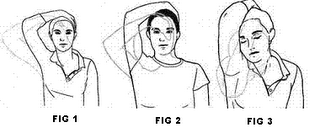
Hold for 30 seconds. Now place your fingers at the back of your skull and gently pull your head straight forward, toward your chest (fig.3). Hold for 30 seconds. Switch hands and repeat the stretches in reverse order: Pull forward, then 45 degrees in front of your left shoulder, and finally directly over your left shoulder. Do not push your head backward.
Do an isometric push against your hand to strengthen the neck. Hold your left palm against the left side of your head(fig.4). Push your left hand against your head while also pushing your head toward your left hand at about half strength. Hold for 30 seconds. Repeat with your right hand on the right side of the head. Do the same exercise, using either hand, with the back of the head (fig.5) and the forehead (fig.6).
|
|
Shoulderstand
Sarvangasana (Shoulderstand) can worsen the problem. As the pose drops your chin toward your chest, it makes it very easy to completely flatten the cervical curve or even curve the neck in the wrong direction. So, if you have a fairly recent, still painful, and acute neck injury like whiplash from an auto accident, avoid Shoulderstand. It would only exacerbate the injury, and practicing it too soon could significantly prolong your healing time.

Half-Circles
Half circles in the front can be done instead. To do this, first drop your chin to your chest. Move your chin towards the right shoulder then back to your chest. Then move your chin towards the left shoulder and back towards the chest. Repeat this movement three to five times.

|
If you continue to have a neck pain, your first task is to learn to reestablish a normal curve in as many situations as possible: sitting at your desk, standing in line at the grocery store, lying in bed.If done properly, all backward bends except Sethu Bandha Sarvangasana (Bridge Pose) engage your neck extensor muscles.

Asanas like Salabhasana (Locust Pose) and Bhujangasana (Cobra Pose) � backbends in which the weight of the head is lifted against gravity � provide the most strengthening benefits for the back of the neck muscles. However, as you practice these asanas, see that you pull your shoulder blades away from your ears and do not to compress the back of your neck. Try to feel as if the cervical curve is distributed evenly throughout your entire neck and you're stretching your neck, even as you bend it backwards.


Chest Expander
Stand up with your feet close together. Bring your hands behind your back and interlace your fingers. Tuck your tailbone in, so you don�t arch your low back too much. As you inhale, lift your hands away from your tailbone. Squeeze your shoulder blades together and you lift your arms and stay in this position for 3-4 breaths. On your next exhale, lower your arms back down. This exercise helps strengthen the muscles in your upper back and relieve tension in your upper back and shoulders.
Arm Lifts
Bring your arms straight out in front of you with your palms facing each other. As you inhale, reach your arms overhead, bringing your arms next to your ears, if you can do so without any pain. As you exhale, bring your arms back down in front of you. Repeat 4-8 times. This helps to relieve tension and build strength in the muscles in the upper back.
Press It
Place the palms of your hand against the back of your head and gently press while resisting with your head. Hold for a count of ten. Repeat with your palm on your forehead.

Treatment for Cervical Spondylosis
Treatment -TYPE A
Exercise your neck and keep active and aim to keep your neck moving as normally as possible. As far as possible, continue with normal activities. In the past, some people have worn a neck collar for long periods when a flare-up of neck pain developed. It is now known that if you wear a collar for long periods it may cause the neck to 'stiffen up'. So, try to keep your it as active as possible.
Professionals who spend hours doing desk work or in front off the computers should take small breaks in between and try and do simple neck exercises.
Some of those neck pains and stiffness which does not improve in spite of exercise and medication are most certainly due to stress. When a person is in constant stress the muscles in the neck goes into spasm and causes pain and stiffness in the neck so it is very important for the doctor to identify the cause and treat it accordingly.
Read more on neck pain and stiffness and learn specific neck strengthening exercises with illustrations.
Treatment - Homeopathy-TYPE B
The symptoms may last for several months or years. Most of the time if symptoms are mild, the doctor may recommend rest, medication, and physical therapy.
Rest - may need to wear a soft cervical collar or neck brace to limit neck motion to relieve nerve irritation.
Medication -medications or other non-narcotic pain relievers to relieve pain and reduce swelling.
Physical therapy - Hot and cold cervical traction or active exercise program to relieve pain symptoms.
When the symptoms are too severe, most of the doctors may recommend surgery. Chiropractic is another alternative of healing for cervical spondylosis treatment.
The most commonly used medicines used are
Rhus Tox ..Pain and stiffness in the nape of the neck pain between the shoulders, Kalmia..pain from the neck down the arms,pain extending to the shoulder blades Conium.. with giddiness. Other commonly used medicines are causticum,calcarea phos,calcarea flour,nux,hypericum.
SPINAL TRANSPLANT 100% EFFECTIVE READ MORE
Treatment - Aurvedic - TYPE C
Any external massage is not of much use. Violent massage with deep pressure is very harmful for the spondylosis patient. Only gentle massage over the muscles of the neck and shoulder joints should be applied and for this purpose Mahanarayan taila is best suited. This gentle massage can be given 2-3 times a day .
In winter season; this medicated oil should be gently warmed before application. Guggulu, gum resin extracted from the plant is the best medicine for the treatment of cervical spondylosis. Ayurvedic physicians for the treatment of this condition popularly use a compound preparation named as simhanada guggulu. It is given in a dose of 2-4 tablets, 4 times a day. Usually hot water or hot milk id given to the patient after the administration of this medicines. This medicine has slightly laxative effects.
For the patient to recover from cervical ailments, it is necessary that this bowel should move clearly and regularly.
This medicine is very much helpful for this purpose. For patients having clear motions, this medicines should be given in a dose of 2 tablets and constipated patients the dose should be 4 tablets. If the constipation is not relieved even by taking 4 tablets the dose can be further increased to 6 tablets. At night some medicines should be given to the patients, which will act as a purgative.
Triphala powder is the best medicine for spondylosis. One teaspoonful of triphala should be given to the patient, mixed with a cup of warm milk and one spoon of sugar. In the motions become regular by the intake of simbanada guggulu, then triphala powder should be given only twice a week otherwise it can be given every day.Hot fomentation on the vertebrae of the is very useful for cervical pains. In a big handkerchief about 500gms of salt should be kept over a frying pan till it becomes tolerably hot. Then this should be applied over the neck. Care should be taken to see that it should not be too hot. In that case, it may cause burns.
Sometimes patients suffering develop some anesthetic patches in the back, neck, shoulders and arms because of the pressure from nervous systems .The patient is therefore not able to feel the quantum of heat applied during fomentation. It should therefore be the responsibility of the attendant to examine the heat of the bolus before applying it on the affected parts .This fomentation should be continued about ½ an hour every day. After fomentation the affected part should not be exposed to cold wind. In winter season therefore immediately after fomentation, the affected part should be covered with some wool engarment.
In other seasons also the affected part should be kept covered with some cotton garments after fomentation. It is very convenient to take the fomentation before bedtime. After the fomentation the patient should go to sleep so that he does not run the risk of exposure. DietSour things particularly curd, are strictly prohibited. Fried things, pulses and various preparations of pulses are also contra- indicated in this condition. Bitter vegetables like bitter variety of drumstick, neem flowers and bitter gourd are very useful. Wheat is better than rice for the patient. He should however, avoid taking refined wheat which is known as maida (flour) and suji (semolina). To some extent they are constipated and do not help the patient in the recovery.
Lifestyle Exposure to cold, cold bath and any violent exercise of the muscles, including pressure, are very bad for the patients of Cervical spondulosis. Under the impression that this pain is being caused by some defects in the muscles, people undertake different types of neck exercises .While reading and writing ,one should maintain a comfortable posture. Morning walk gives some relief to the patient, but if it is cold outside the patient should always use a woolen scarf around his neck while going out of the house.
Surgery
Surgery may be necessary if you have severe pain that does not improve from other conservative treatments. It should be your last resort as there is always a risk factor involved.
Chiropractic is shown to be effective in treating cervical spondylosis. It uses gentle spinal manipulation technique to correct spinal and help to relieve nerve irritation. Spinal subluxation is the term used by chiropractic to describe the misalignment of the spinal vertebrae.
Cervical spondylosis is a treatment disease especially at its early stages. The key is to identify the degenerative condition early and seek treatment. It is important to note that bone degeneration process cannot be cured. The process can only be minimized through healthy diet and lifestyle, exercises and good structural posture.
Spinal Cord injuries in patients
Non-steroidal anti-inflammatory (NSAIDs) Eighty-eight patients over age 40 with traumatic cervical spinal cord injuries were clinically and radio graphically evaluated, and comparison was made with 35 spinal cord injury patients under age 36. While most older patients sustained obvious bony and/or ligamentous damage commensurate with their neurological findings, 25 (28%) of the 88 patients had no demonstrable bony abnormalities and 17 (20%) of the 88 patients had only minimal evidence of bony injury. Of particular interest are the patients with severe cord injuries, yet no bony abnormalities, who seem to form a distinct subgroup of the cervical spinal cord injury patient on the basis of radiographic and clinical features. Of these 25 patients, 24 (96%) had severe cervical spondylosis. Fourteen (56%) of the 25 patients were injured in falls, five (36%) of these 14 being of a seemingly trivial nature. Of the 42 patients with minimal or no demonstrable bony abnormalities, 33 (79%) were evaluated with plain tomography and no occult fractures or other significant pathology was demonstrated. Pant opaque in 27 (64%) of the 42 cases revealed no extruded disk or other surgical lesion in any patient. In large measure, these injuries can be attributed to cervical spondylosis, which narrows the canal and makes the cord more susceptible to compression by the bulging ligament flava during hyperextension.
Back Pain? Try Spinal Transplant - A Chinese Remedy
Victims of chronic back pain were offered fresh hope with news of successful "spinal transplant" surgery. Spinal discs from accident victims were transplanted into patients with disc degeneration in the cervical spine in the cervical spine, the area nearest the neck. All reported improvements in their mobility and a reduction in symptoms such as weakness of legs and bladder.
A report in the Lancet says the pioneering treatment, carried out in china, offers hope for thousands or may be millions of sufferers of severe disc problems, particularly young people.
They often cannot be helped by existing treatments such as spinal fusion - which surgically joins bones in the spine, making them rigid - or artificial material to replace the defective discs. In some cases, these methods cause further degeneration of the disc above and below the area are most affected.
The disc transplants were carried out by doctors at the Navy General Hospital, Beijing, and the University of Hong Kong. Although disc transplants have been carried out in primates, it is a first time doctors have reported such surgery in humans.
The discs consists of cartilage that cushions the individual movements of vertebral bones. When the discs wear away or are damaged by disease, the bones press on nerves, causing pain and restricting movement.
Nia Taylor, chief executive of Back Care, said "It would be very interesting to read the full details because there are a minority of people for whom a problem with discs does not naturally get better. We would welcome any new treatment that can help.
The Chinese doctors used 13 discs, which was frozen and thawed out prior to transplant. Within three months the donor discs had successfully bedded in with existing spinal disc tissue. Now, five years later, all the patients show improvement and none has rejected the donor material.
Read More information about Yoga, Spine, yoga , Massage Technique, Repertory, Back Pain, Spinal cord injury, Anatomy, Homeopathic Treatment, Osteoarthritis, Osteophytes, Symptom